
The 2025 law limits Medicaid and CHIP coverage to permanent residents, Cuban and Haitian immigrants, and migrants from the Compacts. States were required to review affected cases.
As of October 1, 2026, refugees and asylees without green cards are no longer eligible for Medicaid and the Children's Health Insurance Program (CHIP) in the United States. This change stems from a 2025 federal law and also applies to other immigrants with legal status who do not belong to the groups covered by the law, according to a KFF analysis published on September 22, 2026.
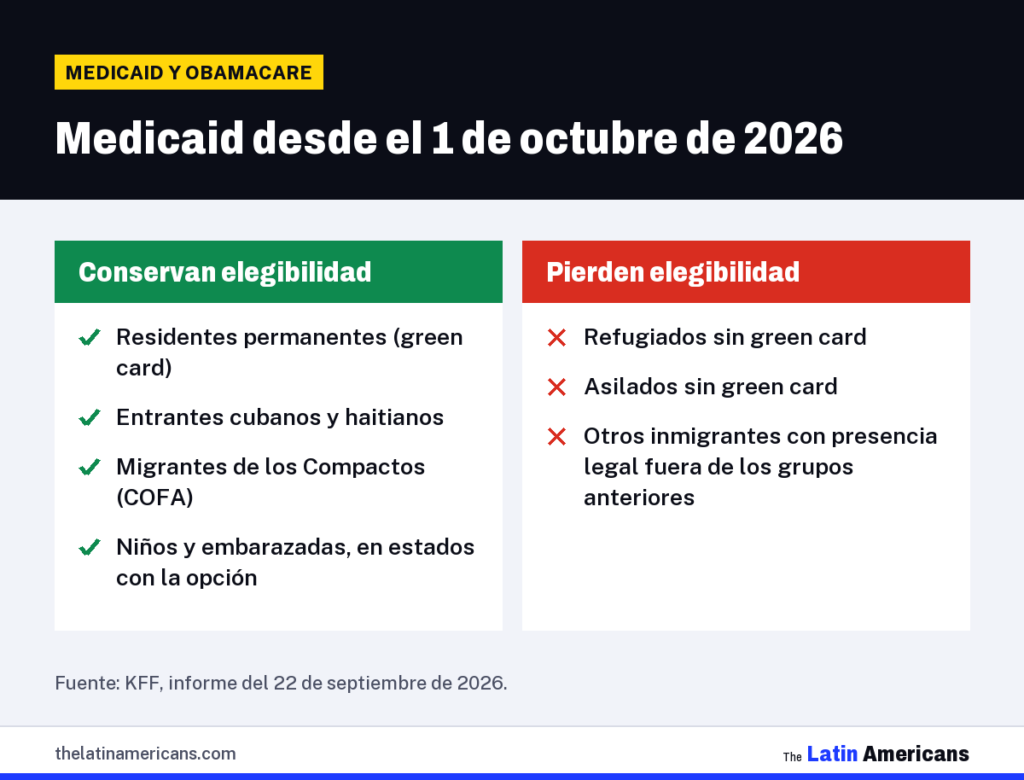
Who retains coverage
According to KFF, Four groups remain eligible:
- legal permanent residents, that is, those who have a green card;
- Cuban and Haitian starters;
- people who reside in the U.S. under the Compacts of Free Association (COFA);
- Children and pregnant women with legal residence, in states that cover them through the ICHIA option.
Immigrants with legal status who fall outside these groups, including refugees and asylum seekers without green cards, lose eligibility. Undocumented immigrants were already ineligible before this change.
What doesn't change
The 2025 law does not change the rule known as PRWORA. Therefore, permanent residents generally remain subject to a five-year waiting period to access Medicaid, with some exceptions. Cuban and Haitian immigrants and migrants from the Compacts are exempt from this waiting period.
The CHIPRA 214 option, or ICHIA, also remains in effect. It allows states to cover children and pregnant women with legal residency without requiring the five-year residency requirement. Coverage varies by state.
Emergency Medicaid and Costs
Starting October 1, 2026, federal payment for emergency Medicaid services for adults who would be eligible except for their immigration status will drop to the regular rate, according to KFF. The analysis also cites that an additional 100,000 people will become uninsured by 2034 and that the Congressional Budget Office (CBO) estimates that Medicaid or CHIP eligibility restrictions reduce federal spending by $6.2 billion.
How states apply it
The Centers for Medicare & Medicaid Services (CMS) issued guidance SHO #26-001 and an implementation tool for states. According to KFF, states were required to redetermine the eligibility of potentially affected enrollees by October 1, 2026, and submit updated amendments to their state plans by December 31, 2026.
The limitations on ACA Insurance Marketplace subsidies, meanwhile, begin on January 1, 2027.
Media outlets and organizations have reported figures for those affected by state, as well as alternative state programs. This data has not been confirmed by official sources and is not included here.
What does it mean to you?
- If you are a refugee or asylee and do not have a green card, your eligibility for Medicaid or CHIP ended on October 1, 2026, according to federal rule.
- If you have a green card, you are still eligible, but the other Medicaid requirements apply, and generally, the five-year waiting period with its exceptions.
- If you are a Cuban or Haitian entrant, or a migrant from the Compacts, you are exempt from that wait.
- If you have children or are pregnant, ask your state Medicaid office if it covers legally resident children and pregnant women through the ICHIA option.
- If you receive a notification about your status, read it completely and respond within the indicated timeframe.
What can you do?
- Check with your state's Medicaid agency to see if your case has been reviewed and what alternatives are available.
- Keep your immigration documents handy when speaking with the agency.
Legal notice: This information is general and does not replace guidance from the official agency or a licensed professional regarding your specific case.