ICE reports 2,618 agreements with local agencies. An investigation into a Texas town of about 1,900 residents describes how the model with the most incentives operates.
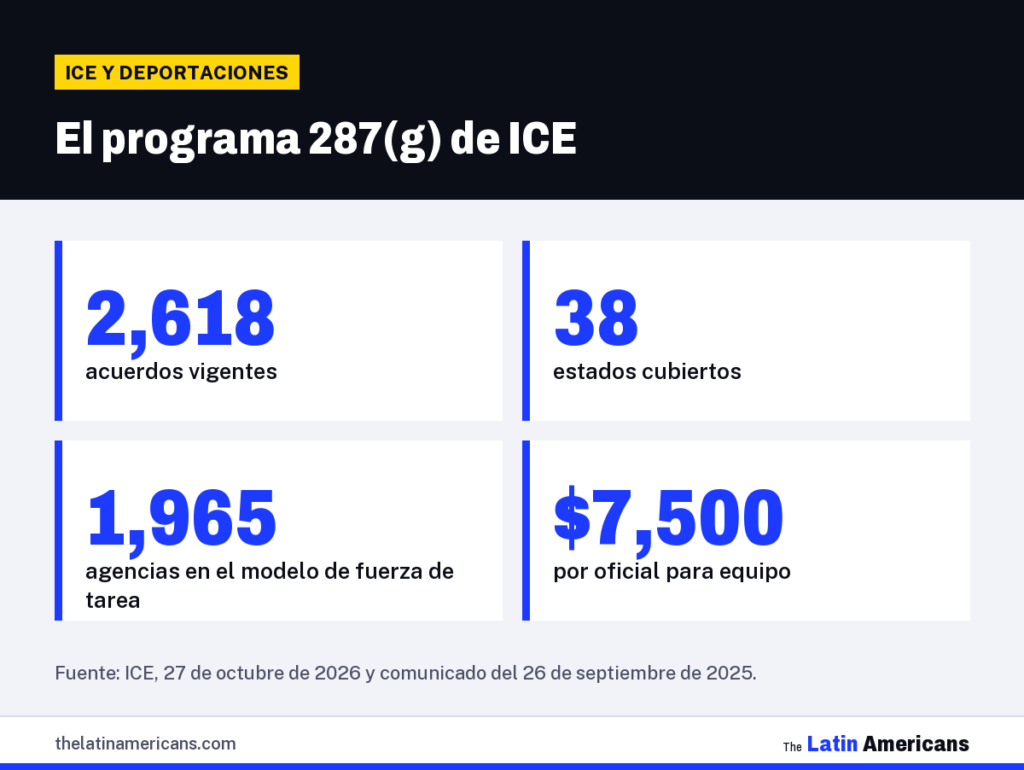
U.S. Immigration and Customs Enforcement (ICE) has 2,618 active 287(g) agreements with local and state agencies, covering 38 states and two territories, according to its official page accessed October 27, 2026. The program is in the news again due to an investigation by ProPublica and The New York Times Magazine into Ingram, a town in Texas.
What 287(g) Is and How Many Agencies Participate
The 287(g) program allows ICE to sign a memorandum of agreement with a local or state agency to delegate some immigration functions to it. It has three models, according to ICE:
- Jail Enforcement: 182 agencies in 29 states and one territory. They identify and process people with pending or active criminal charges.
- Warrant Service Officer: 571 agencies in 34 states. They serve and execute administrative orders against people who are already in custody.
- Task Force: 1,965 agencies in 32 states and two territories. Allows limited immigration actions during routine police work or within an ICE task force.
The total of the three models does not match the 2,618 agreements shown on the page, and ICE does not explain the difference. It also does not indicate what share of the country’s cities participate, so there is no official figure that allows saying how many are left out.
According to ICE, the agency covers the cost of training. Nominated officers must be U.S. citizens and pass a background check; the task force model also requires at least two years of police experience.
Financial incentives
In a statement of September 26, 2025, ICE described $7,500 for each trained and accredited task force officer, for equipment such as laptops, cell phones, and cell service, and $100,000 for each signed memorandum, for vehicles and transportation. In that statement, ICE reported funding for Florida: $10,005,665 for local partners and $28,570,240 for state partners.
The Ingram, Texas Case
According to the investigation by ProPublica and The New York Times Magazine, published October 24, 2026, Ingram has about 1,900 residents, and its police department joined the task force model in October 2025. The report says that, in the following three months, the village’s two patrol officers handed at least 70 people over to ICE, and that over a year the figure amounts to about 10% of the population. It also says police logged 194 immigration-related incidents through August, and that not all of the handovers ended in deportation.
Those figures come from the investigation and have not been confirmed by ICE or the U.S. Department of Homeland Security (DHS).
Online, a video from the @therecount account on TikTok about the case had more than 1.3 million views on October 26, according to material captured by this newsroom. It shows the attention the topic generates; it is not a data source.
What does it mean to you?
- A 287(g) agreement changes what local police can do: under the task force model, a routine contact, such as a traffic stop, can turn into a case with ICE.
- To find out whether your city or county participates, check the list of agencies on the official program page.
- For your specific case, consult an immigration attorney or an accredited legal aid organization.
Legal notice: This information is general and does not replace the advice of a licensed immigration attorney or a representative accredited by the Department of Justice.