
You can remain silent and not open the door without a court order signed by a judge, regardless of your immigration status. How to distinguish between court orders and prepare your family.
Every person in the United States, regardless of immigration status, has the right to remain silent before Immigration and Customs Enforcement (ICE) agents and may refuse to open their door unless shown a warrant signed by a judge. These protections are derived from the Fourth and Fifth Amendments of the Constitution. Constitution, and they explain them in their guides American Civil Liberties Union (ACLU), he Immigrant Legal Resource Center (ILRC) and the National Immigration Law Center (NILC).
The Fourth Amendment protects the right of the people to be free from unreasonable searches and seizures and requires that every search warrant describe the place and the person being sought. The Fifth Amendment establishes that no one can be compelled to testify against themselves.
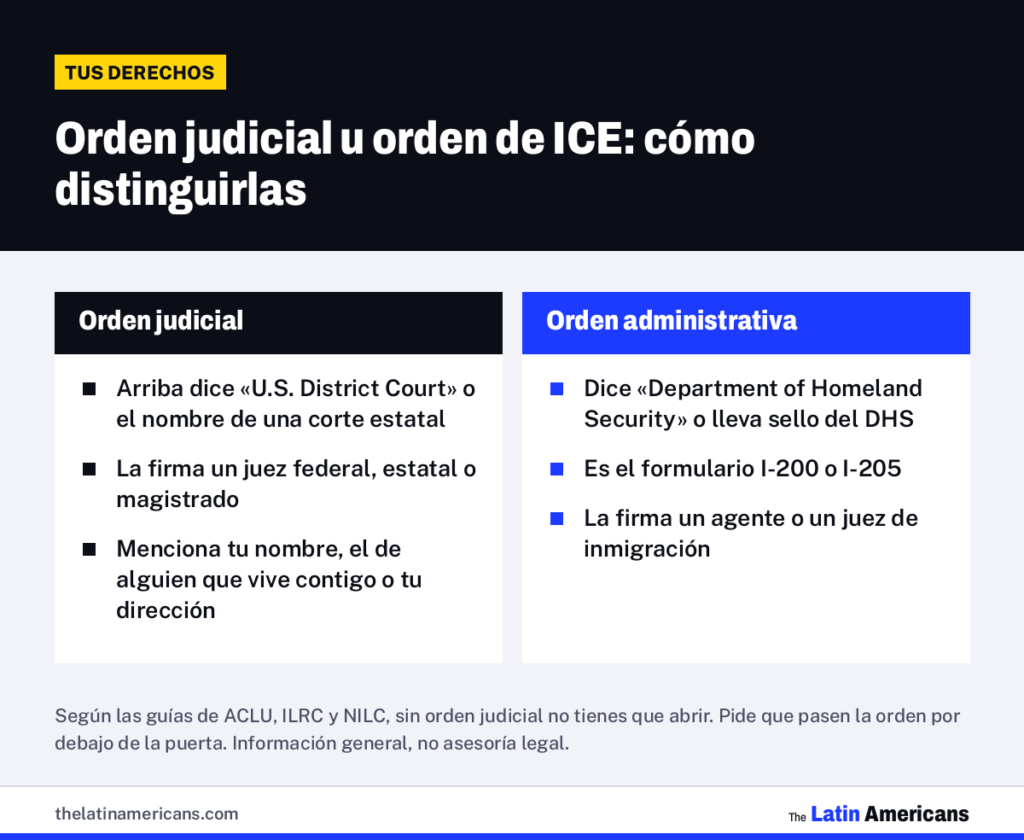
What is the difference between a court order and an ICE warrant?
A court order includes the name of a court, such as "US District Court" or a state court; it mentions your name, the name of someone you live with, or your address, and it is signed by a judge. An administrative warrant is signed by an immigration officer, not a judge, and is usually an I-200 or I-205 form from the Department of Homeland Security (DHS). According to the ILRC, this document allows for the arrest of a person for a civil immigration matter, but it does not authorize entry into a private residence. The NILC clarifies that the signature of an immigration judge does not make it a court order either.
There is a point of contention. An ICE memo dated May 12, 2025, and signed by its then-acting director, Todd Lyons, maintains that Form I-205 is sufficient to arrest a person with a final deportation order at their residence, even by force. ACLU Other lawyers are challenging it on behalf of affected families in a federal court in Washington, D.C., and organizations in Massachusetts have another lawsuit in Boston. In a May 8, 2026, letter to Senator Richard Blumenthal, Homeland Security Secretary Markwayne Mullin said he had paused the practice while he reviewed the policy. In June and July, the administration told both courts that the pause remains in effect and that ICE will not use the I-205 to enter a home without consent while it lasts. The memorandum has not been rescinded, and as of October 19, 2026, neither court has ruled. Legal guidance continues to recommend not opening the door.

What does it mean to you?
- At your home: You don't have to open the door. Speak through the door, ask them to identify themselves, and have them slide the warrant under the door or show it through a window. The ILRC warns that opening the door can be interpreted as permission to enter. If they force their way in, don't resist: say that you do not consent, that you will remain silent, and that you want to speak to a lawyer.
- At work: Officers can enter public areas, such as a lobby, without a warrant. For private areas, they need a warrant or permission from someone in authority, explains the ILRC.
- On the street or in the car: The question is, "Am I free to leave?" If the answer is yes, leave calmly. You can say you don't give permission for them to search your belongings, without physically obstructing them, and you can choose not to answer where you were born or what your immigration status is (see below for what the law says about your documents). Don't run, don't resist, and don't lie.
- If you are stopped: Say, "I want to remain silent and speak with a lawyer." The government will not provide you with a free lawyer. If you fear returning to your country, state this clearly. Inform authorities if you are a parent or guardian of a minor.
- Do not sign anything without advice: The NILC advises against signing anything without first speaking to a lawyer, especially resignation documents.waiver), stipulated deportation order or voluntary departure. Signing them could cause you to lose the opportunity to see a judge.
- Your documents: If you are not a citizen and are 18 years of age or older, the federal law It requires you to always carry the registration document you were given, such as your green card, Form I-94, or G-325R registration slip, according to USCIS. If you have valid immigration status and an agent asks for your documents, the NILC recommends showing them. Never show false documents. The NILC recommends not carrying or showing documents that indicate you were born in another country, such as a foreign passport, and the ILRC advises against showing your consular registration to immigration agents.
Some states have their own rules. For example, in Texas, the Penal Code (section 38.02) It is a crime to refuse to give your name, address, or date of birth to a lawful police officer who has arrested you, and also to stop a driver who does not show their license and refuses to provide that information. Giving a false name or information to a police officer who has stopped you is also a crime.
What can you do?
- Keep a rights card handy. The ILRC offers the «"red cards"», which explain your rights in English and Spanish so you can hand them to the agents without speaking.
- Memorize key phone numbers: a family member, a trusted person, and a lawyer. Seek advice before an emergency; the Executive Office for Immigration Review (EOIR) publishes a list of free legal service providers.
- Decide who will take care of your children If you are stopped, ask a lawyer what documents from your state can give them authority, such as a power of attorney.
- Keep your important documents safe in a safe place and tell a trusted person where they are.
- Share your number A (It appears on your immigration papers) with your family. With it, they can search for you in the ICE detainee locator and review your case in the EOIR case consultation or in their automatic line, 1-800-898-7180, in English and Spanish, 24 hours a day.
Warning: The practical recommendations in this note come from guides provided by legal advocacy organizations (ACLU, ILRC, and NILC), not the government; the rules cited are derived from the Constitution, federal law, and Texas law. If you have a deportation order, an open case, or questions about what documents to bring, consult a licensed immigration attorney or a representative accredited by the Department of Justice.
Frequently Asked Questions
No. The ACLU, ILRC, and NILC guidelines state that you can refuse to open the door unless they show you a court order signed by a judge with your name or address; you can ask them to slide it under the door.
The court order has the name of a court at the top and the signature of a judge. If it says Department of Homeland Security, it's form I-200 or I-205; if it's signed by an immigration officer or judge, it's an administrative order.
Yes. The Fifth Amendment protects everyone in the United States, regardless of immigration status, and you can say you want to remain silent and speak with a lawyer. There are state laws you should be aware of: in Texas, for example, refusing to give your name to a lawful arresting officer is a crime.
Legal organizations recommend not signing anything without first speaking to a lawyer, especially a waiver, a stipulated deportation order, or a voluntary departure, because you could lose the opportunity to see a judge.
With your A number, they can search for you in the ICE detainee locator (locator.ice.gov) and check your case on the EOIR automated line, 1-800-898-7180.
This information is general and does not replace the advice of a licensed immigration attorney or a representative accredited by the Department of Justice. The Latin Americans does not offer legal services.